Xactimate Line Items Cheat Sheet: The Codes I Actually Use Every Week
Article Image
The Codes That Pay the Bills
I've been writing Xactimate estimates since 2014. Started as a restoration tech, worked my way up to project manager, now I run my own shop. I've written somewhere north of 2,000 estimates at this point, and I still have to look up line item codes at least once per estimate.
Xactimate's search function is not great. The naming conventions are inconsistent. And some codes are buried so deep in the category tree that you'd never find them unless someone told you they existed.
So here's my cheat sheet. The stuff I actually use, not the textbook version.
How the Code System Works
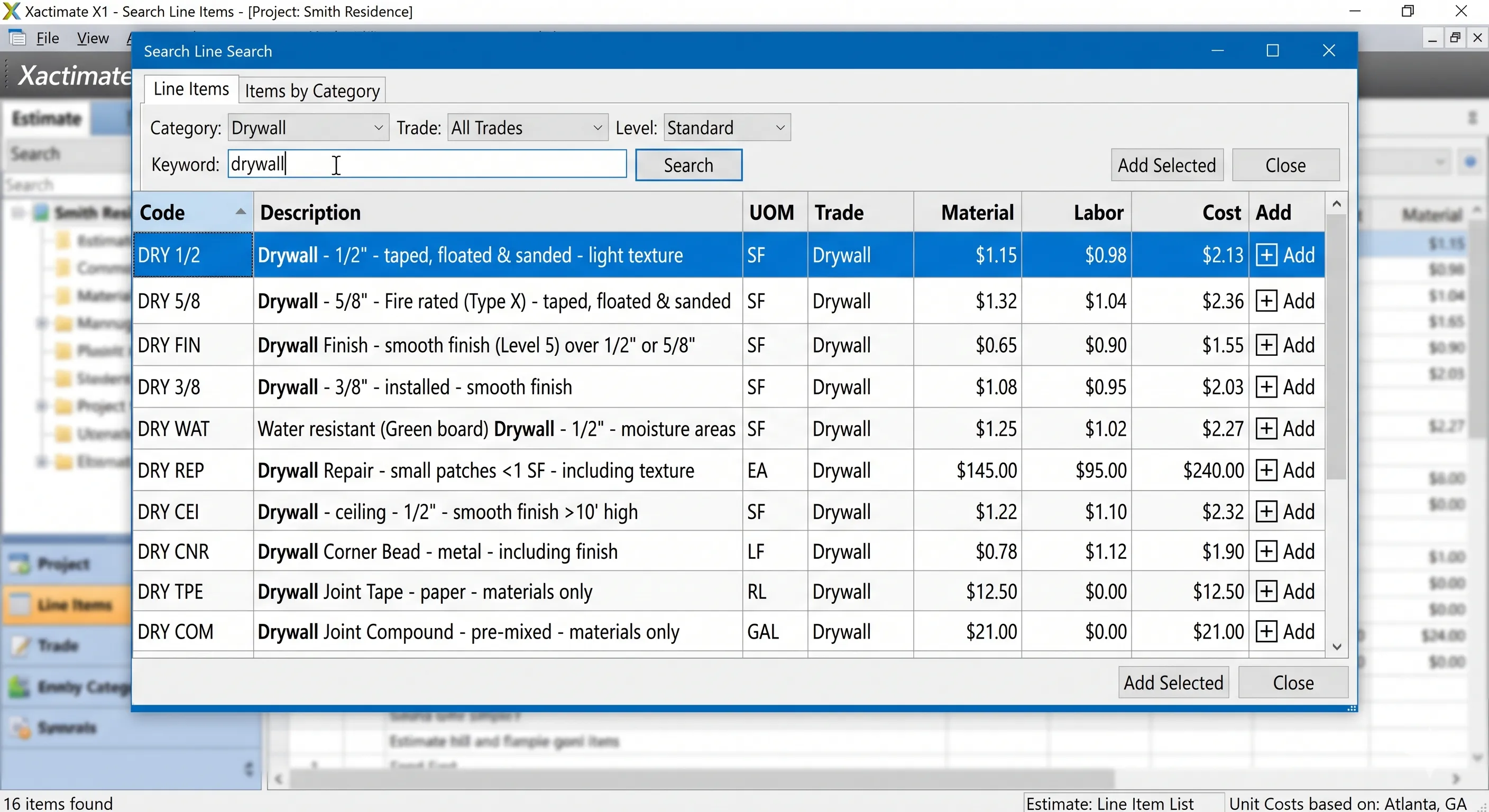
Every Xactimate line item follows a pattern: Category prefix > Item description
Some examples from my last three estimates. RFG LAMI is your standard laminated (architectural) shingle, and this is probably 40% of my roofing estimates right here. DRY 1/2 is half-inch drywall, bread and butter for interior water losses. PNT 2CTS is two-coat paint, and I use this one so often I could type the code in my sleep. Then there's FLR CARP for carpet, usually followed by the pad code and the tear-out code, because you can't replace carpet without removing the old stuff first. Sounds obvious, but I've seen adjusters miss the demo line item. More on that later.
The Codes I Use Most, By Trade
Roofing (RFG)
This is where I make most of my money, so I know these cold:
| Code | What it is | Watch out for |
|---|---|---|
| RFG LAMI | Architectural/laminated shingle | Make sure you spec the right weight: 25-year vs 30-year vs lifetime |
| RFG 3TAB | Three-tab shingle | Barely used anymore but carriers still scope it on older homes |
| RFG FELT15 | 15# felt underlayment | Some roofers spec synthetic instead, different code |
| RFG DRIP | Drip edge | Adjusters love to leave this off. Fight for it. |
| RFG STRTR | Starter strip | Another one that gets "forgotten" |
| RFG RDGCAP | Ridge cap shingles | Don't use the field shingle code for the ridge. Different item. |
| RFG ICE | Ice and water shield | Required by code in most states. 3 feet from eave edge minimum. |
Missing any one of these on a roofing estimate is basically handing the carrier a reason to kick it back.
Drywall (DRY)
| Code | What it is | Notes |
|---|---|---|
| DRY 1/2 | 1/2" drywall | Standard interior walls |
| DRY 5/8 | 5/8" drywall | Required for ceilings and garage walls in most jurisdictions |
| DRY FIN | Drywall finishing (tape, mud, sand) | This is separate from the board itself. Don't forget it. |
| DRY TEX | Texture (orange peel, knockdown, etc.) | Matching existing texture is its own nightmare |
Painting (PNT)
| Code | What it is | Notes |
|---|---|---|
| PNT 2CTS | Two-coat repaint (walls) | Standard for most interior claims |
| PNT SEAL | Seal/prime (stain blocker) | Essential after water damage, use Kilz or BIN |
| PNT TRIM | Trim paint | Baseboards, casings, crown. Per LF, not SF. |
Demolition (DEM)
| Code | What it is | Notes |
|---|---|---|
| DEM DRY | R&R drywall demo | Remove AND replace, this covers taking the old stuff out |
| DEM FLR | Flooring demo | Carpet, tile, whatever. Separate from the new install. |
| DEM HAUL | Debris haul-off | Per load. Carriers will fight you on the number of loads. |
The Pricing Thing
Here's something that took me too long to understand when I was starting out.
Xactimate prices are NOT what you charge. They're what the insurance company will pay.
Verisk updates the pricing database every month based on regional surveys. A line item might pay $3.50/SF in rural Arkansas and $6.20/SF in Manhattan. The prices include labor and materials for most items, but the labor rates are based on Verisk's data, and that doesn't always match what contractors actually charge in 2026.
This is a constant source of tension. Every contractor I know has war stories about Xactimate pricing being too low for their market. Material costs spiked 30-40% during COVID and the price lists took months to catch up. Lumber and shingles went through the roof (no pun intended) and we were stuck billing at pre-spike rates.
You can request price list adjustments through your carrier, but good luck with that.
Mistakes That Get Estimates Rejected
I mentor a few younger estimators, and I see the same mistakes over and over.
Forgetting R&R (remove and replace) labor. You can't install new flooring without removing the old flooring. But I see estimates all the time that include the new carpet install and skip the tear-out. That's free money you're leaving on the table. Worse, the carrier accepts your estimate and you eat the demo cost.
Wrong unit of measure. Roofing is per SQ (square = 100 SF). Drywall is per SF. Trim is per LF. Fixtures are EA (each). I once saw a guy scope a roof in SF instead of SQ and the estimate came out 100x too high. The carrier's reviewer had a good laugh.
Always include O&P when three or more trades are involved. Carriers reject it 85% of the time when included, but 100% of the time when you don't ask.
Leaving off O&P. Overhead & Profit, 10% overhead plus 10% profit, is supposed to be added when you've got three or more trades on a job. Water loss with demo, drywall, paint, and flooring? That qualifies. But a lot of estimators don't add it because they don't want to fight the carrier. Here's the thing: carriers reject O&P about 85% of the time when it IS included. They reject it 100% of the time when you don't even ask for it. Always include it. Make them tell you no.
Net vs. gross measurements. When I measure a room for drywall, I measure the whole wall, gross area. Then I subtract doors and windows. A lot of new estimators measure net area only (just the drywall surface) and forget that the waste factor exists. Xactimate has a built-in waste factor for most items. Use it.
Missing supporting items. A roof isn't just shingles. It's also ice and water shield, underlayment, drip edge, starter strip, ridge caps, pipe boots, step flashing, chimney flashing, vent flashing, and haul-off. I've seen adjuster estimates that include the shingle line item and literally nothing else. That's not an estimate, that's a wish.
Written by
Tony Reeves
General Contractor & Xactimate Certified Estimator
Frequently Asked Questions
Thousands. I don't know the exact count and I doubt anyone outside Verisk does either. But for my day-to-day work, I probably use maybe 80-100 codes regularly. The rest are specialty items you look up when you need them.
Depends who you ask. Carriers think they're fine. Contractors think they're low. The truth is somewhere in the middle. They're based on regional surveys and updated monthly, but they don't always keep up with material price spikes. During COVID, prices were months behind the real market.
Overhead and Profit, 10% each, so 20% total on top of the estimate. The industry standard is to include it when three or more trades are involved. Carriers push back on it constantly, but you should always include it when it's warranted and let them be the ones to remove it.
Use keywords, not codes. Type 'architectural shingle' instead of trying to remember RFG LAMI. Xactimate's search is mediocre, but it works better with descriptions than with code memorization. I also keep a personal cheat sheet in a spreadsheet for the codes I use most.
Convert Your PDF Estimates to Xactimate
Upload a PDF and get an editable ESX file in minutes. No manual data entry required.
Try Free ConversionPractical next steps